

Ahead of the Trump-Xi summit, some reflections on politics, international relations, and the global economy.

Photo by Matthew Pearce on Unsplash
A few weeks ago, I attended two events that I thought might be worth reporting back on for readers. In both cases I was invited to speak on the intersection of geopolitics and economics.
One was behind closed doors, so I’m not at liberty to name it. The other was the 11th Delphi Economic Forum, Delphi being the site of the eponymous oracle of the ancient world. Think of it as a mini Davos – an ambitious event with a global reach, reflected in a very international composition of topics and speakers. I will focus my debriefing on Europe and the transatlantic relationship, and geoeconomics.
Europe
From overregulation … Every write-up on Europe has to start with overregulation, and I will oblige, not least because as a macro analyst I am always keen to listen to business leaders who have a grass roots view. Among the examples I heard were: businesses having to contend with two layers of regulation (country and EU); EU supply chain reporting requirements; expensive packaging; and requirements related to the EU’s carbon border adjustment mechanism (CBAM). On AI, one criticism was that Europe regulates it as if it is a mature industry (I would add that this is a mistake the EU makes in many places, not just AI).
... to “glass half full”. Business people and analysts both expressed their frustration at the fact that while leaders know exactly what to do (Draghi and Letta reports!) they are still dragging their feet. People from the financial industry were understandably focused on the “savings and investment union” – harmonizing withholding tax and insolvency laws anyone? – and lamented that the banking market remains fragmented (I’ll suppress my rant here about the German government’s opposition to the takeover of Commerzbank by UniCredit!).
Yet widespread impatience over Europe’s slow speed to act on virtually all fronts combined with a “glass half full” view driven by the recognition that while significant issues and – to use a military term – capability gaps remain, Europe is on the move. Regular readers know that this is a frequent theme of this newsletter. I perceived a consensus that the EU was going to increasingly have to proceed via “coalitions of the willing” (unless it got rid of unanimity / the ability of countries to veto). This could possibly include defence spending, which may have to be taken outside the EU treaties.
Ukraine: from burden to asset. In foreign and security policy, what was notable was the change of narrative on Ukraine, as it is being recognised that the country is turning from a security consumer to a security provider. The export of drone-related technology to Middle Eastern countries underlines this, and the bigger picture is that with its large, experienced army and technological know-how, Ukraine has now become essential for Europe’s security. An American international relations expert even thought that Russia is again globally irrelevant: bogged down in Ukraine, and with little influence left in the Middle East after the ousting of Assad in Syria – a regional power.
US-Europe: it’s complicated
A key theme in both events was the state of the transatlantic relationship in the era of Trump - and beyond. I’ve also had the chance to speak on the sidelines some people aligned with the current US administration, including persons formerly holding positions in Trump 1 or 2.
More things unite us ... It was refreshing that several people from both the US and Europe thought that fundamentals still united the two sides of the Atlantic, and that included economics: apparently, Norway and Belgium hold more US government debt than China, and more than half of US LNG exports go to Europe (fact check: 68%, January-November 2025). Beneath the headlines, NATO was seen to be working – enhanced security cooperation in the Arctic being an example.
Former officials of Democratic US administrations counselled Europe to be strategically patient and play the long game. Trump was already a lame duck, and – for all his mix of neo-isolationism and neo-imperialism – he would not withdraw the US from NATO because there was no personal benefit for him (congressional hurdles aside).
While I agree in principle that there is more that unites us than divides us, I found the stark divergence between Trump-aligned interlocutors and those who were from Democratic administrations hardly reassuring.
... or do they? I’m not at all inclined to absolve Europe from its policy failures, and many Europeans have arranged themselves rather too comfortably in an intellectual position where they blame Trump for those failures. For example, the EU should (and by now does) pay for every dime the US spends on Ukraine. Yet I found both tone and substance of the Trump-aligned people at best unhelpful, and most of the time laden with hubris and ignorance. The strategic implication for Europe has to be to mind its own business – if only because every x years there is the prospect of a US administration that’s outright hostile. And that is at least until the Republican party frees itself from Trumpism – which I don’t think is likely anytime soon for deeper reasons.
On the Iran war, people aligned with the Trump administration said that it would be a good thing for there to be regime change – no disagreement from me. But then there were a lot of complaints about “people sniping from the sidelines” and the double standards of having given the Obama administration years to negotiate the JCPOA while now everyone wants results immediately. My response was that this comparison simply didn’t make sense: the Trump administration has handed Iran the mother of all chokepoints and that the clock was ticking on a global recession, so a certain degree of impatience was inevitable.
Interestingly, many of the same people - all staunch Republicans - thought that the invasion of Iraq in 2003 was a mistake. I reminded them that back then most of Europe didn’t think that the invasion of Iraq was a good idea and that Europe got a lot of opprobrium from the Bush administration for it (remember Rumsfeld’s “old Europe” putdown?). When I asked whether they thought that one day they might also come to consider the Iran war a mistake and that Europe might be vindicated again, I was met with mute stares.
Geoeconomics
Business leaders at both events had a lot to say about how geopolitics reshapes the business environment. Trust has become more of an issue, in turn depending a great deal on where “the other side’s” country belonged geopolitically. Naturally, uncertainty was a problem, which companies try to deal with by using more scenario analysis in planning and, in their business dealings, through diversification of supply and/or less trade but more vertical integration wherever possible. Naturally, establishing resilience through redundancy in supply chains is costly, and the uncertainty creates a risk premium which weighs on margins.
In my various remarks, I summarized the situation in four points.
Technology has become a major driver of geopolitical rivalry. And this is not just about advanced technologies like AI or semiconductors. It also extends to software, electric vehicles, and a wide range of industrial and consumer technologies that increasingly sit at the centre of strategic competition between states.
Part of the reason is that technology is not a single product or sector — it is a chain. Because of the vertical dimension of technology, rivalry stretches all the way down to the level of primary materials (think rare earths). In turn, this vertical dimension increases the fragmentation of the global economy.
Framework uncertainty and trust. More broadly, once trust breaks down because of geopolitical rivalry, the world stops being frictionless. Things that once looked like ordinary commercial questions suddenly become matters of national security. And when that happens, chokepoints begin to appear everywhere.
Some chokepoints are geographical. The Strait of Hormuz is an obvious one. But increasingly there are technological and product-level chokepoints too: antibiotics, masks, semiconductors, batteries, industrial inputs. Some chokepoints are both geographical and technological, e.g. Taiwan’s dominance in advanced semiconductor manufacturing.
What makes the current moment particularly difficult is that the instability runs deeper than normal economic uncertainty. We are no longer simply dealing with uncertainty within a stable framework. Increasingly, there is uncertainty about the framework itself. And once the framework becomes unstable, almost anything can be interpreted as touching on sovereignty.
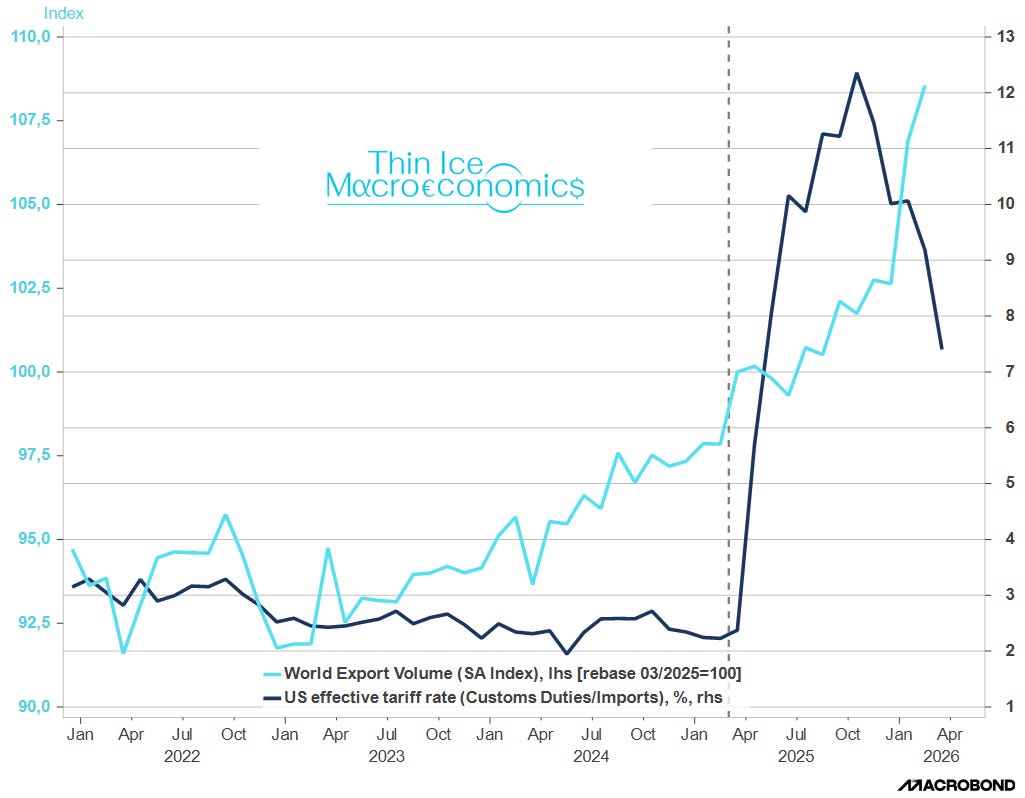
Source: US Census Bureau, CPB, Macrobond
Resilience paradox. Even as technology becomes a major arena of geopolitical competition, it has also acted as a stabilising force for the global economy through trade.
The US effective tariff rate, for example, has increased roughly fourfold prior to the SCOTUS IEEPA ruling (chart above). Yet global trade has continued to grow, supported in significant part by technology exports. According to the IMF’s World Economic Outlook, Asian technology exports have continued to expand at double-digit annual rates. So while technology is driving rivalry, it is also, at least for now, helping sustain the resilience of the global economy through the resilience of trade itself.
Trade imbalances cause and a consequence of geopolitical antagonism. On the American side, protectionism under the Trump administration was fuelled politically by losses in manufacturing employment that were linked — in Trump’s narrative — to persistent trade deficits. On the Chinese side, the resurgence of large trade surpluses is partly driven by a push for self-sufficiency and technological leadership, shaped by the view that the United States is actively trying to constrain China’s rise.
“While I agree in principle that there is more that unites us than divides us, I found the stark divergence between Trump-aligned interlocutors and those who were from Democratic administrations hardly reassuring.”
100% - and adding to this, it would evidently be strategic suicide for Europe to hop right back into the same security, political, and economic arrangements with the US as pre-Trump, even under democrat leadership in 2028
Great piece. I loved your insight on the “vertical dimension” of technology, and why the concentration this entails reinforces geopolitical fragmentation. Also, the idea that anything and everything can be a chokepoint in such an uncertain environment is really interesting, and equally really important, when considering shifting global dynamics.